Why Silica Gel Has No Business Being Near Your Food (And What Does)
Patrick SassanoYou've seen it many times. A tiny packet tucked inside a beef jerky bag, a vitamin bottle, or a box of crackers. Bold black letters stamped across the front: DO NOT EAT.
And yet, here it is. Sitting inches from your food.
For decades, silica gel has been the default desiccant or moisture absorber in packaging across nearly every industry. It's cheap, it's abundant, and somewhere along the way, the food industry adopted it without asking a question that really should have been asked a long time ago: Just because something isn’t toxic for you, does that make it safe to put next to your food? For food manufacturers, that question is becoming more important.
"Non-Toxic" Is Not the Same as "Food-Safe"

This is the distinction that most consumers and some manufacturers miss entirely.
Silica gel is classified as non-toxic. That means if a child tears one of those little packets open and eats some, you're probably not rushing to the emergency room. But non-toxic is a baseline. It's the bare minimum standard that means this won't immediately poison you. It says nothing about food contact safety, regulatory compliance, or what happens after prolonged exposure to the contents of your packaging line.
The FDA draws a clear line between substances that are non-toxic and substances that are approved for direct food contact. Silica gel does not appear on the FDA's list of substances approved for direct food contact packaging. It is a synthetic material made from silicon dioxide processed with various chemical binders and it was never designed to sit against the product your customer is about to consume.
Fiber desiccants were.
What Is a Fiber Desiccant, Exactly?

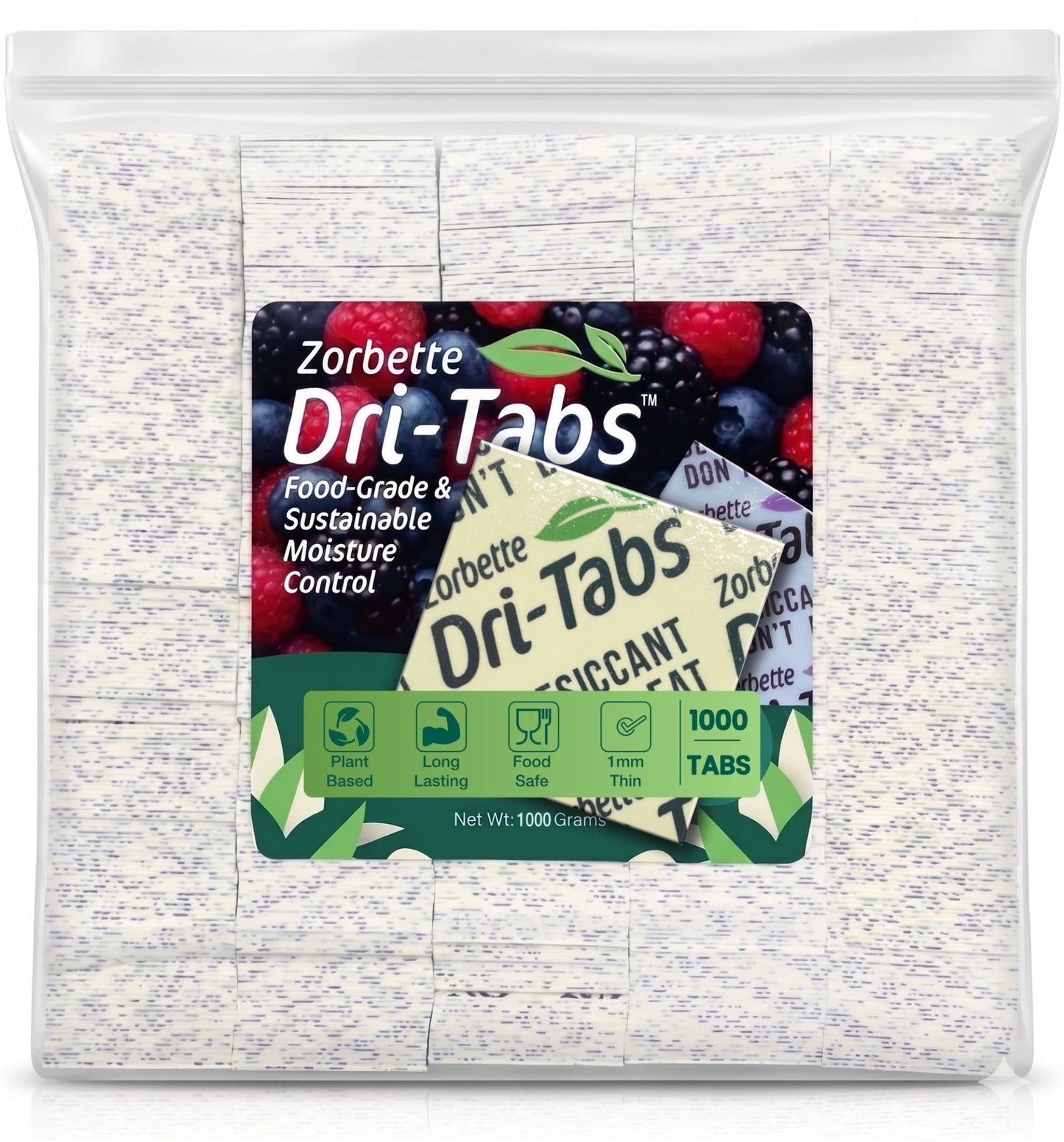
Fiber desiccants, sometimes called cellulose desiccants, are made from natural plant-based materials, typically hibiscus plant fibers, wood pulp or other food-grade cellulose matrix fibers. The same basic category of material used in food packaging, coffee filters, and paper used in direct food contact applications for generations.
Because of their natural composition, fiber desiccants can be manufactured to meet FDA food contact standards, making them appropriate for placement directly inside food packaging, not just tucked into the corner of a box hoping nothing migrates.
They absorb moisture and humidity just as effectively as silica gel across standard humidity ranges. They don't require a warning label telling consumers not to eat them. And critically, if a packet ever tears or degrades inside a food package, something that absolutely happens across high-volume production and distribution, you aren't left wondering what synthetic compound just made contact with your product.
Silica Gel vs. Fiber Desiccant: A Side-by-Side Comparison

| Criteria | Silica gel | Fiber Desiccant |
|---|---|---|
| Material origin | Synthetic — silicon dioxide with chemical binders | Natural — plant-based wood pulp / cellulose fiber |
| FDA food contact approval | Not approved — not on FDA food contact substances list | Approved — manufacturable to FDA food contact standards |
| Consumer warning required | Yes — "Do Not Eat" labeling required | No — no consumer warning needed |
| Packet failure risk | High risk — synthetic crystalline particles may contaminate product | Low risk — food-contact material even in failure scenarios |
| Moisture absorption performance | High across standard humidity ranges | Comparable across standard humidity ranges |
| Clean label compatibility | Incompatible — synthetic origin conflicts with clean label positioning | Compatible — natural origin aligns with clean label standards |
The Categories Where This Decision Matters Most
Not all food packaging carries equal risk when it comes to desiccant selection. But there are several product categories where the choice between silica gel and a food-safe fiber alternative is particularly consequential and where manufacturers have the most to gain from making the switch.
Freeze-Dried Foods
Freeze-dried products are among the most moisture-sensitive items in the food manufacturing space. The freeze-drying process removes nearly all residual water content to extend shelf life and preserve nutritional integrity, but that same low moisture profile makes the product extremely aggressive at reabsorbing ambient humidity the moment packaging is compromised or improperly sealed.
For manufacturers in this category (whether producing emergency food kits, camping meals, or retail snack products) desiccant performance is non-negotiable. But so is desiccant safety. Freeze-dried products often sit in sealed pouches or cans for months or years before consumption. That is a long time for a synthetic silica gel packet to be in close proximity to food items, and a long window for packet degradation, seal failure, or particulate migration to become a liability issue.
Fiber desiccants offer the same moisture-control performance in this application with the added assurance that the packet material itself is food-contact compliant. This is a meaningful distinction when shelf life is measured in years, not weeks.
Dehydrated Foods
Dehydrated vegetables, fruits, jerky, and dried grains share many of the same moisture sensitivity challenges as freeze-dried products, with one additional complication: texture and product integrity. Moisture reabsorption in dehydrated foods doesn't just affect safety, it also affects crunch, chew, clumping, and overall product quality in ways consumers notice immediately.
In this category, manufacturers are often already investing heavily in barrier packaging that includes mylar and foil-laminate pouches to protect product quality. A food-safe fiber desiccant is the logical choice to that investment. Introducing a synthetic packet into an otherwise clean, compliant packaging system is an inconsistency that becomes harder to justify as clean-label expectations continue to tighten.
Spices and Seasonings
Spices present a unique challenge. They are aromatic, fine-particulate products that are almost always used directly in food preparation with no barrier between the product and the consumer. Clumping and caking from moisture exposure are among the most common quality complaints in this category, making effective desiccation critical.
Fiber desiccant tabs, made from food-grade materials, change the calculus on that worst-case scenario. They are available in solid state formats meaning risk of tearing, puncturing and spilling are non-existent.
The Contamination Risk Nobody Talks About
Packets fail. Seals break. Product gets jostled in transit, stored too long, or handled roughly on a warehouse shelf. When a silica gel packet fails inside a food package, you now have a synthetic crystalline substance in contact with or potentially mixed into your product.
Fiber desiccant tabs, by contrast, are made of materials that, even in a worst-case failure scenario, are food-contact compliant. The packet itself behaves more like packaging material than a foreign object.
For food manufacturers, that distinction matters enormously from a liability standpoint. It matters to your QA team, your regulatory affairs department, and your legal counsel. And increasingly, it matters to the retail buyers and co-packers who are beginning to ask the question themselves.
So Why Is Silica Gel Still Everywhere?
One word - Cost.
Silica gel is inexpensive to produce at scale, and it's been the industry default long enough that most procurement decisions never revisit the question. It works well enough at its core job (absorbing moisture) so the "if it ain't broke" logic kicks in.
But the cost-benefit math is shifting. As clean-label expectations harden into retail requirements, and as FDA food contact compliance becomes a more visible part of supplier audits and brand due diligence, the modest per-unit premium for a fiber desiccant starts to look less like a cost and more like an insurance policy.
The Bottom Line
The next time your QA team is revisiting packaging standards, put the desiccant question on the agenda. Not because silica gel is going to cause an immediate crisis. But because food manufacturing has always moved in the direction of higher standards. Brands that lead that shift, rather than react to it, are the ones that earn customer trust.
Fiber desiccants are effective. They are food-safe. They are available at scale. And they are the right answer for any manufacturer serious about putting the best possible product into the hands of their customer.
The "DO NOT EAT" warning on your moisture packet should not be the last thing standing between your brand and that standard.
Interested in making the switch to food-safe fiber desiccants for your production line? Call to an expert at 877-8-ZORBET.